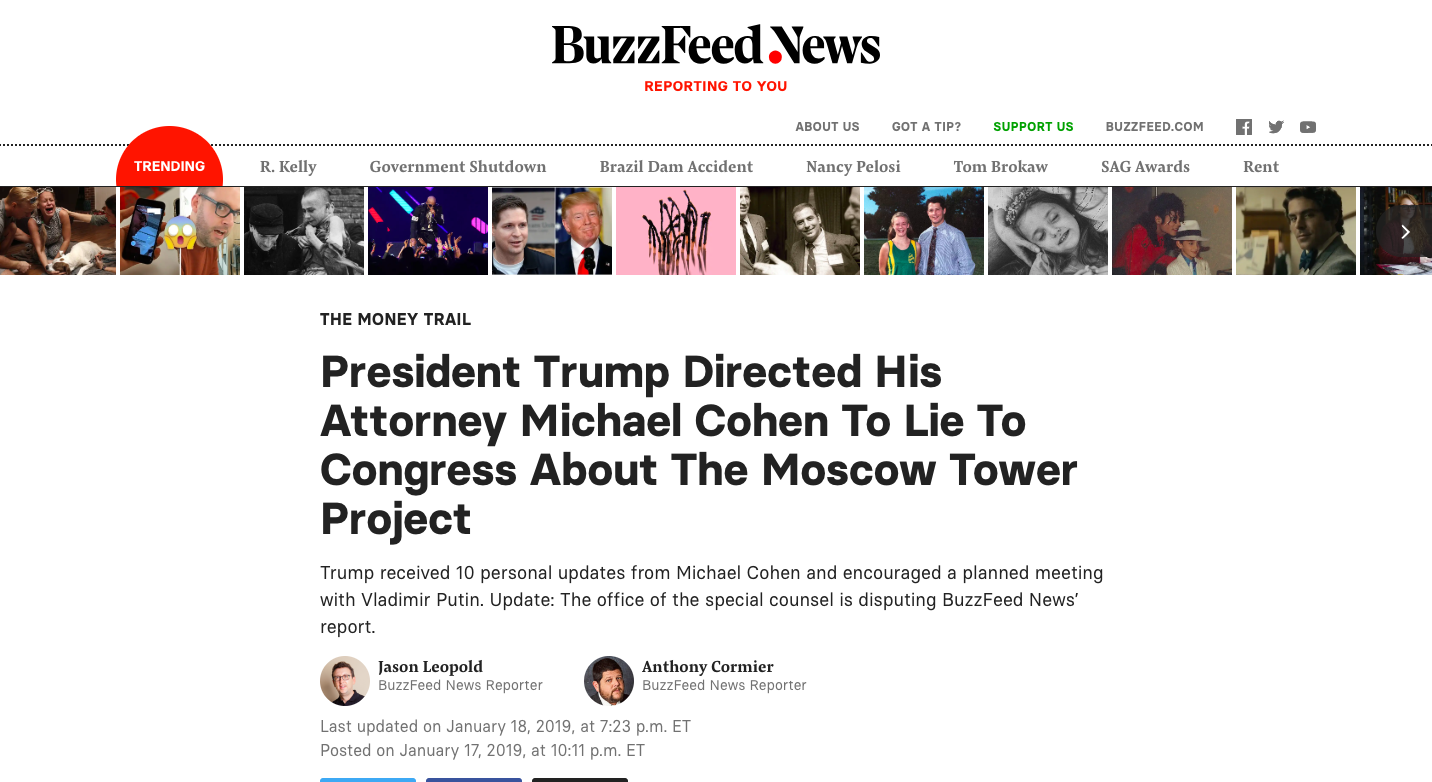
Can you trust an article that supports its central argument on anonymous sources? Well, Buzzfeed News’ article, “President Trump Directed His Attorney Michael Cohen To Lie To Congress About The Moscow Tower Project,” informs the audience that POTUS influenced Cohen to lie according to two unnamed “federal law enforcement officials.”
The authors of this article include Jason Leopold and Anthony Cormier, both of whom are award winning investigative journalists. The author’s purpose of this message is to expose President Trump for his manipulative influence on his attorney and the potential effect this has on the Mueller investigation. Furthermore, despite these journalists having distinguished careers, the institution that they represent does not obtain a newsworthy presence. According to Pew Research Center, Buzzfeed is deemed as the least trustworthy news source by “ideological group.” Part of the reason behind this rating is due to the content displayed and reported on the central Buzzfeed page, which include celebrity quizzes, restaurant video reviews, and other random listicles. According to John McManus’ “SMELL” test, the source of this information includes these two unnamed persons, which would be categorized as a “secondary source” (McManus). Since the position of the anonymous sources is not disclosed, the proximity of the source to President Trump is unclear; therefore, the information contains uncertainty and can be invalid. Moreover, the second part of the PIE test addresses the independence, which dissects whether there is freedom from a conflict of interest (McManus). Based on the two unnamed sources’ willingness to expose the President shows their loyalty doesn’t align with the current administration. The last part of the PIE test puts into question the expertise of the source, which questions the sources’ level of intelligence and experience on the matter. As for these two sources, which are the only sources that confirm this article’s argument, there is no certainty as to how informed they are on whether President Trump did tell Cohen to lie in front of Congress. Overall, I think the relationship between the authors and the sources is not relatively close. Since the article begins with this dramatic claim, which is supported by these two unnamed sources, and then recounts the history of Cohen lying throughout the Mueller investigation, I would argue the sources do not have enough power or security to outrightly reveal their identity. In addition, I think Buzzfeed News is attempting to create distance from the normal and fun Buzzfeed, in order to gain more of a reputable newsworthy presence, which prompted the release of this article without more probing of additional credible sources for confirmation.
The next part of the “SMELL” test addresses the motivation of the article, which is to expose President Trump and inform the audience that he “directed” Cohen to lie to Congress (Buzzfeed). According to the article, the authors claimed, “Cohen’s testimony marks a significant new frontier: It is the first known example of Trump explicitly telling a subordinate to lie directly about his own dealings with Russia” (Buzzfeed). This statement proves that the authors intentionally wrote this article to attack POTUS and to inform the audience that he is a self-interested and unfit President. Based on the images chosen by Buzzfeed, I would also argue that it paints him in a shady and untrustworthy way, in which one of them shows he is weirdly grimacing. These photos enhance the central argument; however, I don’t think these were chosen to engage and attract the audience’s attention, which was captured by the lengthy title.
Evidence is a crucial part to every argument. Based on the “SMELL” test, the reporters used evidence from two anonymous sources, which proves the authors didn’t witness it themselves, but learned it from one or more sources (McManus). People may interpret this article’s lack of transparency with its sources as not credible. Alternatively, others may argue this article is credible because its written by distinguished journalists who are backed by a well-known brand. For instance, the authors didn’t quote the sources themselves but claim the sources “have told buzzfeed news that Cohen also told the special counsel that after the election, the President personally instructed him to lie- by claiming that negotiations ended months earlier than they actually did- in order to obscure Trump’s involvement” (Buzzfeed).
To logically understand this political turmoil outlined in this article, the “SMELL” test questions if this information makes sense, internally and externally, based on the evidence presented (McManus). After conducting my own research, the story of Cohen’s history of lying on Vox is parallel to that of Buzzfeed’s; however, the evidence provided in the article cannot be confirmed because the sources are unnamed.
The last part of this test questions what is left out, which is a counterargument. It omits the opposite perspective; therefore, making it less objective and heavily one-sided. I think this omission implements a subtle bias against POTUS; therefore, explaining the motivation behind this article.
Overall, I think this article is not reliable. Yes, we all have heard of Buzzfeed, but compared to the NYT, where there are verification methods and processes to vet a source because the value of journalism is high, I think Buzzfeed News is less credible, especially with the evidence coming from two anonymous sources.
 Chowing Down on Culture